Speed of Sound in an open tube
1) Determine the speed of sound in air using resonance in an open tube.
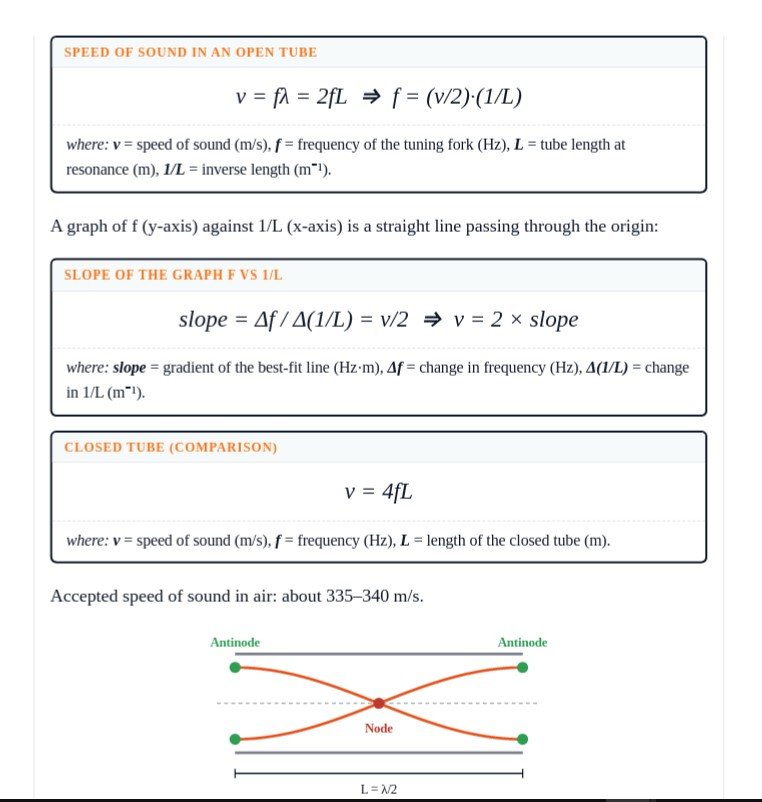
2) Show that frequency f is directly proportional to 1/L, and find v from the slope.
Sound is a longitudinal wave. A wave consists of an oscillation in some medium. Ocean waves are transverse waves in water (the water molecules oscillate perpendicular to the direction of propagation of the wave). Sound waves are longitudinal waves in air (the air molecules oscillate in the direction of propagation of the wave). All waves are characterized by the following parameters:
Amplitude — for sound waves, related to how “loud” the sound is.
Period — the time between one maximum and the next.
Frequency — the number of waves per unit time = 1/Period.
Wavelength — the distance between one maximum and the next.
Velocity — the speed with which the wave propagates in a medium; usually constant.
Since speed times time gives distance traveled, the velocity of the wave times the period equals the wavelength:
WAVE RELATION
λ = vT = v / f
where: λ = wavelength (m), v = speed of sound (m/s), T = period (s), f = frequency (Hz).
As a sound wave propagates in a tube, it is reflected from each end and interferes with itself. If the wavelength and frequency of the wave are just right for the tube, the forward going waves interfere with the reflected ones and form standing waves in the tube. We say this tube is at “resonance” with the sound waves and the frequency “resonant frequency”. The condition for the existence of such standing waves is mostly determined by the physical constraint of the tube.
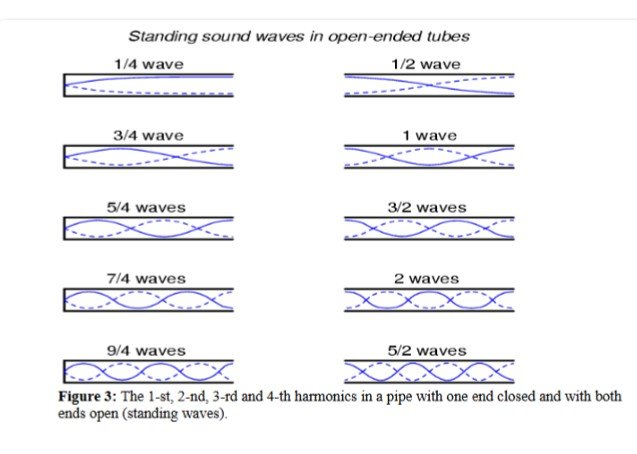
For open ended tubes (both ends are open), air molecules are free to move at both ends, allowing maximal displacements at the ends. Therefore, anti-nodes for the displacement are expected at both ends of the tube. For closed-end tubes (one end closed, the other open), the motions of air molecules are constraint at the closed-end, allowing minimal displacements. Therefore, a node for displacements is expected at the closed-end and anti-node at the open end.
The first three standing wave modes of the closed case are shown in Fig. 3 which are called the first, second, and third harmonics, respectively. In this experiment, an open-end tube is used to study the standing waves in a tube produced by sound waves. The length of the tube determines the wavelengths of the sound waves that could form standing waves in the tube. As shown in Fig. 3, the distance between adjacent nodes or adjacent anti-nodes corresponds to half of the wavelength. Therefore, the wavelength of the n-th harmonic, λₙ, is related to the length of the tube, L, through the following equation.
1.Tuning forks with different frequencies: 512, 480, 426.6, 341.3, 320 Hz 2.Resonance tube (adjustable, open) Tube stand (holder)
3.Ruler / meter stick
- Set up the tube vertically and prepare the tuning forks.
- Arrange the tuning forks in order of frequency, from highest to lowest (512 Hz down to 320 Hz).
- Strike a tuning fork and hold it above the tube opening.
- Adjust the tube length until the loudest sound is heard (resonance). Measure L, record f and L, and compute 1/L.
- Repeat for each tuning fork.
- Plot f vs 1/L, draw the best-fit line, and compute the slope; v = 2 × slope. Note: tube length = 33 cm.
Media Gallery