Maxwell's Wheel
To measure the acceleration of Maxwell's wheel as it unwinds down its threads, verify uniformly accelerated motion (h ∝ t²), and determine the wheel's moment of inertia I experimentally to compare with the theoretical value.
Maxwell's wheel is a disc of mass M and radius R fixed on a thin axle of radius r, hung by two threads wound around the axle. When released, gravity pulls the centre of mass downward while the threads unwind and force the wheel to rotate. The wheel therefore performs two motions at once: translation of its centre of mass (speed v) and rotation about the axle (angular speed ω). If the threads do not slip, the two are linked by the unwinding radius r :
V=ωr ,, a=αr
Because r is tiny compared with R, the wheel must spin very fast for even a small downward speed, so almost all of the released energy goes into rotation.
Rotational motion and moment of inertia Rotation obeys the same laws as translation, with each translational quantity replaced by its rotational analogue:
Translation , Position x, speed v, acceleration a
(Mass m (resists change of v)) , Force F = ma
Kinetic energy = ½mv²
Rotation , Angle θ, angular speed ω, angular acceleration α
(Moment of inertia I (resists change of ω)) , Torque τ = Iα
Kinetic energy = ½Iω²
The moment of inertia measures how the mass is distributed about the axis: mass far from the axis contributes much more, because it enters as r^2.
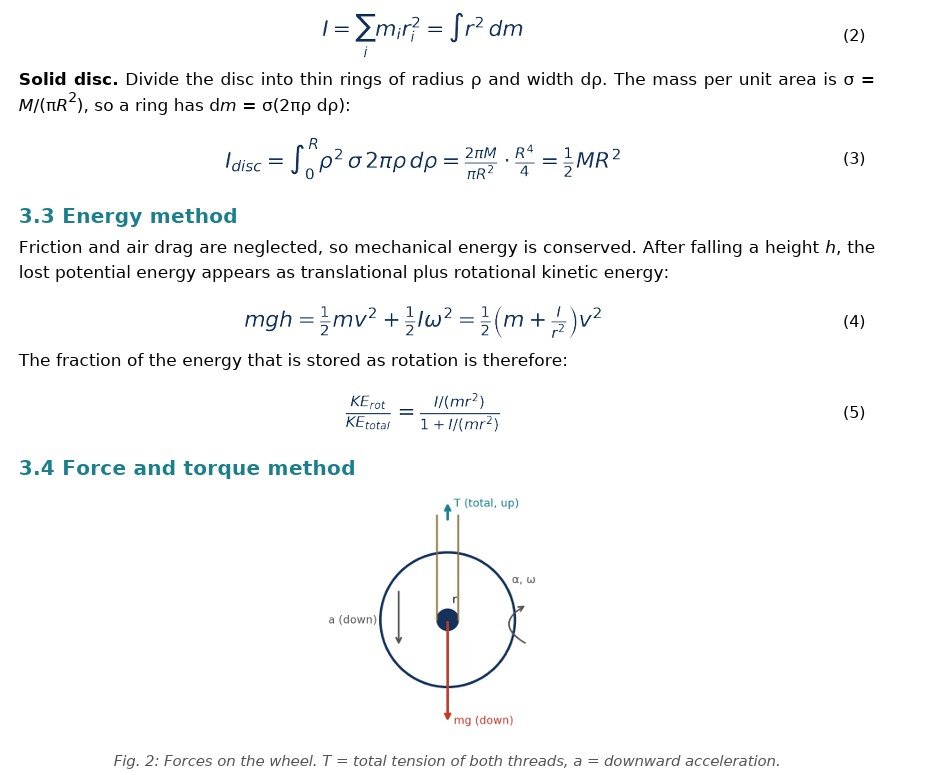
Two forces act on the wheel: its weight mg (down) and the total thread tension T (up). Newton's second law for the centre of mass, taking down as positive: (6) The weight acts through the centre of mass and gives no torque. The tension acts at distance r from the axis, so Newton's law for rotation gives, with α = a/r:
1.Maxwell's wheel
2. Two threads, support frame
3.Meter Stick
3.Stopwatch
4.Vernier caliper
5.Balance
Media Gallery